Night
Astraeus
ἈστραῖοςRoman: Astraeus
Married the dawn and fathered the winds and every star in the sky.
- 1
- epithet
- 0
- cult sites
- 0
- offspring
- 0
- unions
- 1
- recorded birth
Vitals
- Kind
- Titan
- Generation
- 2
- Domains
- the stars, the winds, dusk
- Accent
- Night — darkness, the moon, sleep, the crossroads
- Sacred symbols
- the star-map, the four winds
- Principal cult sites
- No cult attested
What they were called
Ἀστραῖος
of the stars
Lineage
See in the treeDescent
Mother: Eurybia, daughter of Pontos and Gaia, outside the v1 roster.
Offspring in this roster
None recorded among the figures modelled here.
Notable myths
The Winds and the Stars
Eos bore to Astraeus the winds — Zephyros, Boreas and Notos — and then Eosphoros the dawn-star and all the stars that crown the sky. Hesiod adds a pointed line: those are the well-born winds. The destructive gusts that wreck ships come from Typhon instead, and are not related to these at all.
Hesiod, Theogony 378-382
The account
Astraeus exists in the Theogony for four lines and they are unusually productive ones. Eos bore to him the strong-hearted winds — Zephyros who clears the sky, swift Boreas, and Notos — and after the winds she bore the Dawnstar and all the shining stars with which heaven is crowned. That is the whole entry. It makes him responsible, jointly with the dawn, for weather and for the night sky, two systems the Greeks otherwise kept apart. The pairing has a logic: the stars are visible until dawn erases them, and the winds turn at dawn, so a marriage between the evening sky and the morning is a reasonable way to explain both. Nonnos, writing in Greek in the fifth century CE, gives him a late career as an astrologer who casts a chart for a visitor. There is no cult and no image. He is a genealogical joint, and one worth keeping because so much hangs off it.
Ancient sources
- Hesiod, Theogony 375-377
- Hesiod, Theogony 378-382
Where a line reference is not given, the work is cited without one rather than guessed at.
Image credit
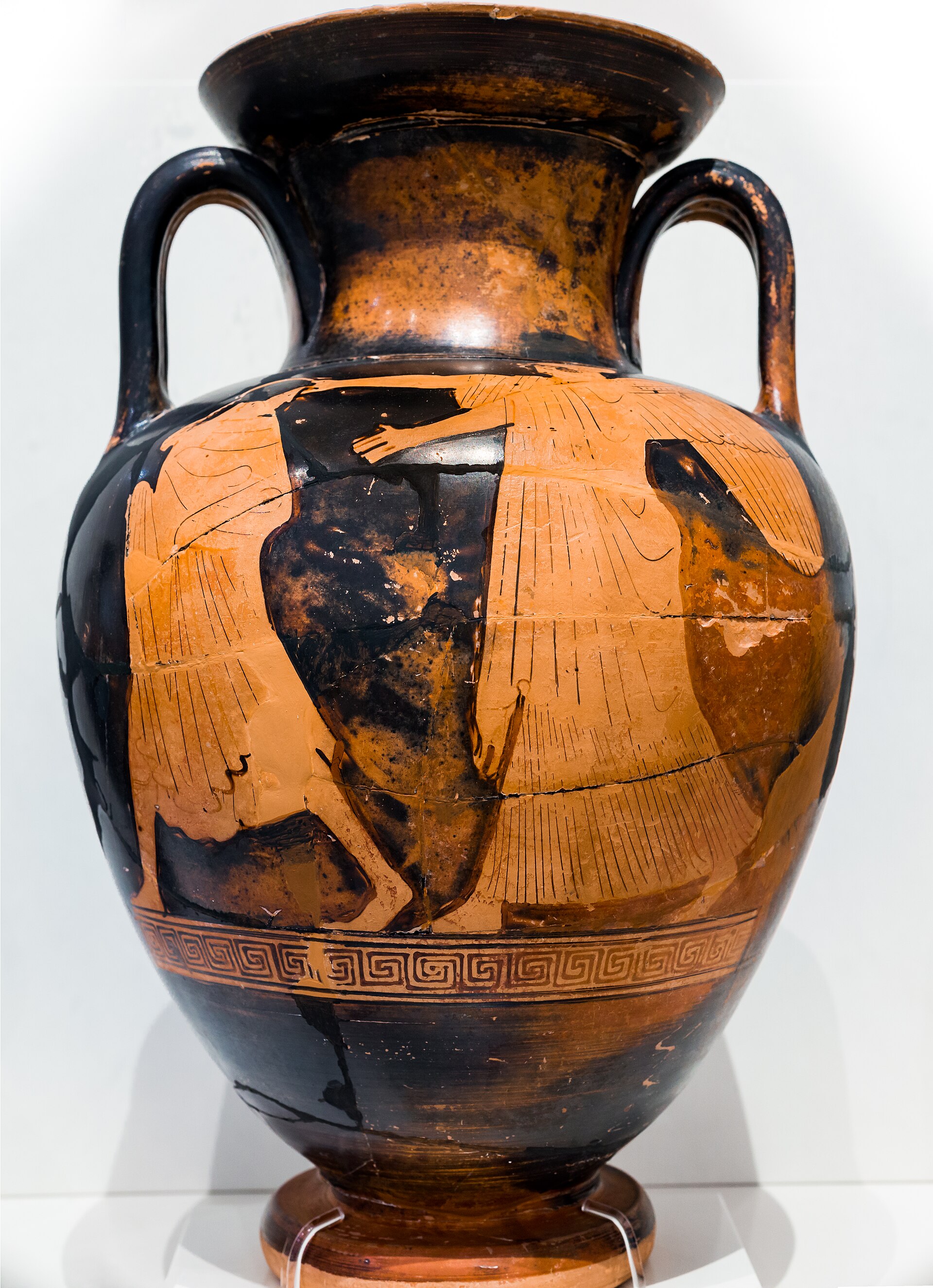
No classical portrait of this figure survives, so the mark on this page is generated from their Greek initial and their domain accent rather than taken from an artwork.