Where the sources disagree
The ancient authors were not writing a single reference work between them. They were separated by centuries, by region and by purpose, and on some questions they simply contradict each other — not in detail, but about who a god’s parents were and what kind of being they are.
Picking one reading and staying quiet about the rest would make this site tidier and would be an editorial claim the evidence does not support. So both are recorded, one is marked primary because the graph has to draw something, and the disagreement is shown as a disagreement.
Three cases are set out below. They were chosen because each one breaks a different thing: the first changes the shape of the tree, the second changes what a god is, and the third is barely about genealogy at all.
Aphrodite has no mother, or she has an ordinary one
Two accounts that place the same goddess two generations apart, and the only one that changes the drawing.
- Hesiod, Theogony 188-206
Hesiod
Recorded as primary
She is older than the Olympians and sits in the Titan band, contemporary with the generation that produced Zeus.
- Homer, Iliad 5.370-372
Homer
Variant tradition
She is a daughter of Zeus, two generations further down, and every view on this site would redraw around her.


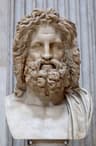
Hesiod tells it as an act of violence with a long aftermath. Kronos cuts his father, throws the parts into the sea, and white foam gathers around the immortal flesh until a girl grows in it and comes ashore. There is no mother. The father was already finished by the time she formed. This Aphrodite is not the goddess of romance; she is the force that makes the cosmos go on reproducing itself, and Hesiod needs her early.
Homer never mentions any of it. In the fifth book of the Iliad she is cut on the battlefield and runs crying to her mother Dione, and Zeus tells her — not unkindly — to leave fighting to others and keep to the things she is good at. She is a daughter here, junior, embedded in a family, being managed by her father. No sea, no foam, no severed anything.
These are not two tellings of one story. They are two gods sharing a name.
This is the one disagreement on the site with a structural cost, which is why Hesiod's account is the primary record rather than a coin toss. Accepting Homer's would move Aphrodite out of the Titan band and in among the children of Zeus, and the shape of the family would change on every page that draws it. The data validator knows: it carries a rule that lets a parentage record contradict the generation banding, provided the record says out loud that it is doing so.
Eros is the oldest god, or he is a child of two Olympians
A disagreement that reads as parentage and is really about what kind of thing Eros is at all.
- Hesiod, Theogony 116-122
Hesiod
Recorded as primary
No parent recorded — Hesiod names them among the first things.
Desire is a cosmic principle, present before there is anyone to feel it, and answerable to nobody.
- Apollodorus, Bibliotheca
Apollodorus and after
Variant tradition
Desire is an Olympian's errand boy: junior, embodied, and firmly inside the family it serves.

In the Theogony, Eros is named among the very first things — with Chaos, with Gaia — before there is anything to desire or anyone to do the desiring. That placement is an argument, not a flourish. Everything Hesiod describes after Chaos is produced by union, so a principle of attraction has to already be in place before the cosmos can start generating anything at all. Eros is that principle, and he is prior to the whole story.
The later tradition makes him the son of Aphrodite and Ares: desire born of love and war. It is a good line, and it is a completely different god — the boy with the bow, an attendant, a figure who acts on other people's feelings rather than being the reason feelings exist.
The chronology folds in on itself, and nobody in antiquity appears to have minded. In Hesiod, Aphrodite is not born for two more generations; the familiar version makes the oldest god the child of someone younger than he is. Read strictly, it is a paradox. Read as the ancients seem to have read it, it is simply what happens when a cosmological abstraction acquires a personality and a mother.
So the parentage record is not really where this disagreement lives. It is only where the disagreement becomes visible in structured data. What is actually contested is rank: whether Eros is a condition of the universe or a member of its household staff.
Dionysos is twice-born, or he is torn apart and reassembled
The case a family tree cannot hold: not a second set of parents, but a second religion attached to the same name.
- Hesiod, Theogony 940-942
The common account
Recorded as primary
A god with a mortal mother, carried to term by his father — extraordinary biography, ordinary theology.
- Diodorus Siculus, Library of History 5.75.4
The Orphic account
Variant tradition
A god murdered as an infant and remade, whose death explains what human beings are made of.
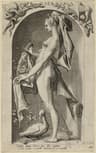
The familiar Dionysos is the son of Zeus and Semele, a mortal princess of Thebes. She asks to see her lover undisguised and is destroyed by the sight; Zeus takes the unborn child from her body and carries it sewn into his thigh until it is ready. Hence twice-born. It is a strange story, but it is a story about a birth.
The Orphic account keeps the name and replaces everything under it. Zeus fathers a child on Persephone, in the underworld. The Titans lure the infant away with toys and a mirror, tear him to pieces and eat him. Zeus burns them out of existence, and human beings are formed from what is left — part Titan, and part the god the Titans had just consumed.
That is not a variant birth. It is a doctrine, and it does work no genealogy is built to do: it explains why people are the mixture they are, and it underwrites a mystery cult with a teaching about the soul and what happens to it afterwards.
The site records it as a second parentage because that is the only handle the data model offers. A family tree can carry two sets of parents without strain. It cannot carry the claim that the human soul is a surviving fragment of a dismembered god — and flattening the Orphic Dionysos into a footnote about his mother would lose the more interesting half of the disagreement.