Underworld
Persephone
ΠερσεφόνηRoman: Proserpina
Taken as a girl, returned as a queen, and no longer entirely her mother's.
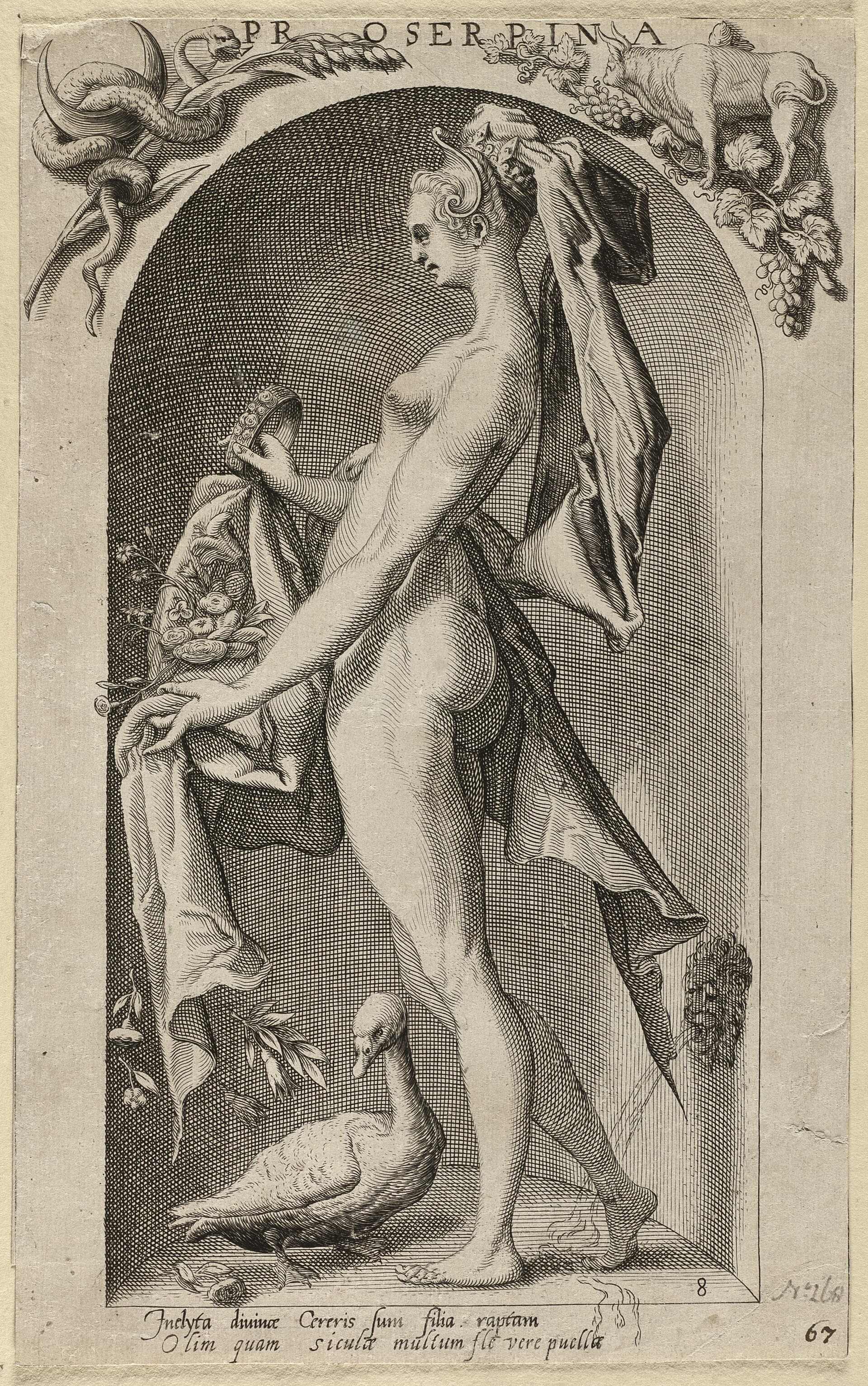
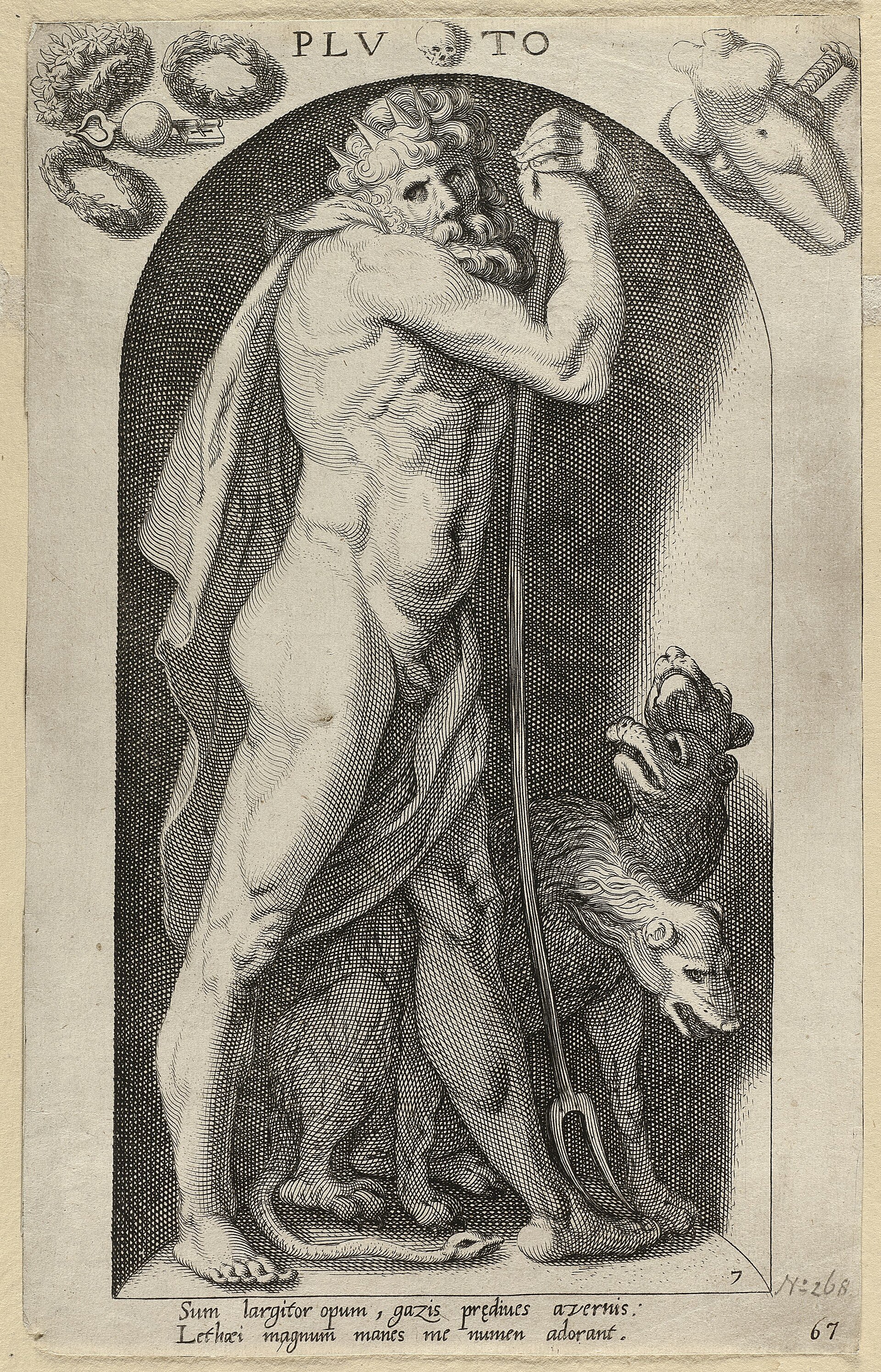
Engraving, 1598 — Noord-Hollands Archief
- 4
- epithets
- 4
- cult sites
- 1
- offspring
- 1
- union
- 1
- recorded birth
Vitals
- Kind
- Chthonic
- Generation
- 3
- Domains
- the underworld, the returning year, the seed under the ground
- Accent
- Underworld — the dead, the pit, what is under the ground
- Sacred symbols
- the pomegranate, the torch, the narcissus, the sheaf
- Principal cult sites
- Eleusis, Locri Epizephyrii, Enna, Lokroi
What they were called
Κόρη
the girl — her name before the marriage
ἁγνή
holy, set apart
ἐπαινή
the dread one
Πρωτογόνη
first-born — in the Orphic hymns
Lineage
See in the tree
Notable myths
The Narcissus in the Meadow
Persephone was gathering flowers with the daughters of Okeanos when she reached for a narcissus with a hundred blooms, grown by Gaia at Zeus's request as a lure. The ground split, Hades came out with his immortal horses, and he had her in the chariot and gone before she finished screaming. Only Hekate, in her cave, and Helios, in the sky, heard it.
Homeric Hymns, Hymn to Demeter 1-39
A Third of the Year
Zeus sent Hermes down to bring her back. Hades let her go and gave her a pomegranate seed as she left. Because she had eaten in his house she could not leave it entirely, and the terms were fixed: a third of the year with him, the rest above with her mother. Demeter let the grain grow again and the settlement has held ever since.
Homeric Hymns, Hymn to Demeter 334-403
The account
Persephone is picking flowers in a meadow — roses, crocuses, violets, and a narcissus that Gaia grew as a trap — when the ground opens and Hades takes her. Zeus had agreed to it in advance. The Homeric Hymn follows her mother, not her, and we get the girl's own account only briefly at the end, when she tells Demeter what happened and admits she ate the pomegranate seed, saying he made her take it by force. The settlement gives her a third of the year below and two-thirds above, and the Greeks read the crops off that. But she does not simply become a seasonal mechanism. In the underworld she is a queen with real authority: it is Persephone the shades appeal to, Persephone who releases Eurydike, Persephone who sends up the dead to be questioned. Homer's standard phrase for the place is the house of Hades and dread Persephone. She has two names for two halves of a life, Kore before and Persephone after, and Greek women knew exactly what that meant.
Ancient sources
- Hesiod, Theogony 912-914
- Homeric Hymns, Hymn to Demeter 1-39
- Homeric Hymns, Hymn to Demeter 334-403
Where a line reference is not given, the work is cited without one rather than guessed at.
Image credit
- Title
- De godin Proserpina. NL-HlmNHA 1477 53010129
- Artist
- Mander, Karel van (I) (1548-1606), Braeu, Nicolaes (werkzaam ca.1586-ca.1600), Schonaeus, Cornelius (1541-1611), toegeschreven aan
- Date
- 1598
- Licence
- Public domain
