Sun
Helios
ἭλιοςRoman: Sol
Sees everything that happens, and is called as a witness for exactly that reason.
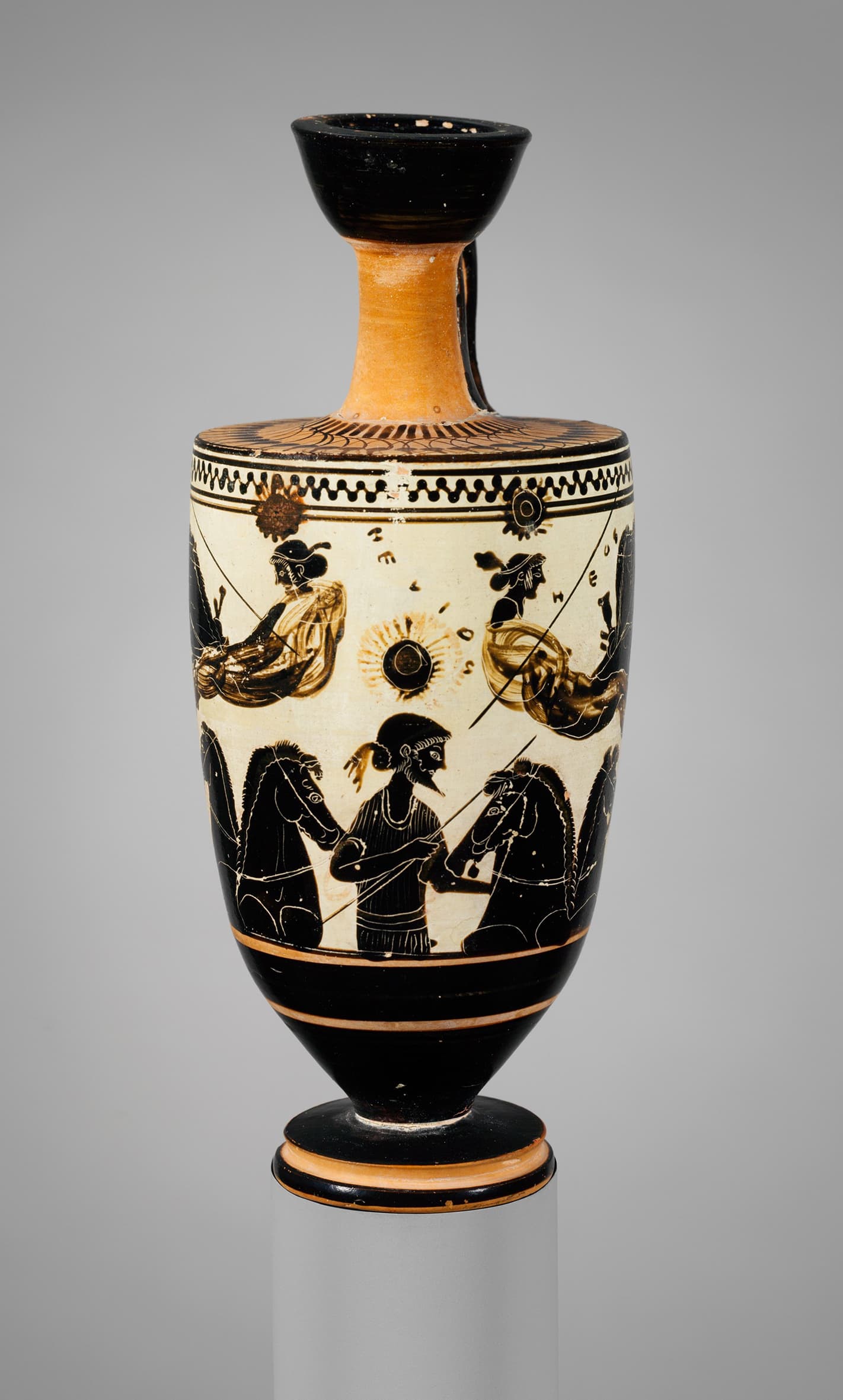
White-ground lekythos, Sappho Painter — c. 500 BCE, Metropolitan Museum of Art
- 3
- epithets
- 2
- cult sites
- 1
- offspring
- 0
- unions
- 1
- recorded birth
Vitals
- Kind
- Titan
- Generation
- 2
- Domains
- the sun, sight, oaths sworn on what he saw
- Accent
- Sun — daylight, the dawn, far-shooting brightness
- Sacred symbols
- the four-horse chariot, the radiate crown, the cattle of Thrinakia
- Principal cult sites
- Rhodes, Corinth
What they were called
πανόπτης
all-seeing
Ὑπεριονίδης
son of Hyperion
ἀκάμας
untiring
Lineage
See in the tree
Notable myths
The Witness for Demeter
Demeter searched nine days for her daughter and no god or man would tell her anything. On the tenth Hekate brought her to Helios, and Helios answered directly: Zeus gave the girl to Hades, and it was Hades who carried her off screaming. He is the only figure in the hymn who simply says what happened.
Homeric Hymns, Hymn to Demeter 62-89
The Cattle of Thrinakia
Seven herds of fifty cattle grazed on Thrinakia and Odysseus's men were warned twice to leave them alone. Starving, they killed and roasted them while he slept; the hides crawled and the meat lowed on the spits. Helios told Zeus that if he was not paid for it he would go down and shine among the dead instead. Zeus broke the ship with a thunderbolt and every man aboard drowned but one.
Homer, Odyssey 12.260-419
The account
Helios drives the sun across the sky in a four-horse chariot and, because of the vantage, functions as the standing witness of the Greek world. When Demeter cannot find Persephone it is Helios who tells her plainly what happened and who did it. When Ares and Aphrodite are in bed it is Helios who sees and reports to Hephaistos. Oaths are sworn by him and by Gaia together — the one who sees everything and the one who receives everyone. He also has one long story of his own. His son Phaethon asked to drive the chariot for a day; Helios had sworn by the Styx to grant any request and could not take it back; the boy could not hold the horses, the earth caught fire, and Zeus struck him out of the sky to stop it. And the last of Odysseus's crew die because they eat his cattle on Thrinakia after being told twice not to. He is not vengeful by temperament. He is simply the god who always finds out.
Ancient sources
- Hesiod, Theogony 371-374
- Homeric Hymns, Hymn to Demeter 62-89
- Homer, Odyssey 12.260-419
Where a line reference is not given, the work is cited without one rather than guessed at.
Image credit
- Title
- Lekythos. Sappho painter. Helios, Nyx and Eos, ca. 500 BCE. The Met
- Artist
- Ismoon ( talk ) 21:17, 14 March 2022 (UTC)
- Date
- Unknown
- Licence
- CC BY-SA 4.0
