Sun
Eos
ἨώςRoman: Aurora
Opens every day in Homer, and keeps carrying off young men who then get old.
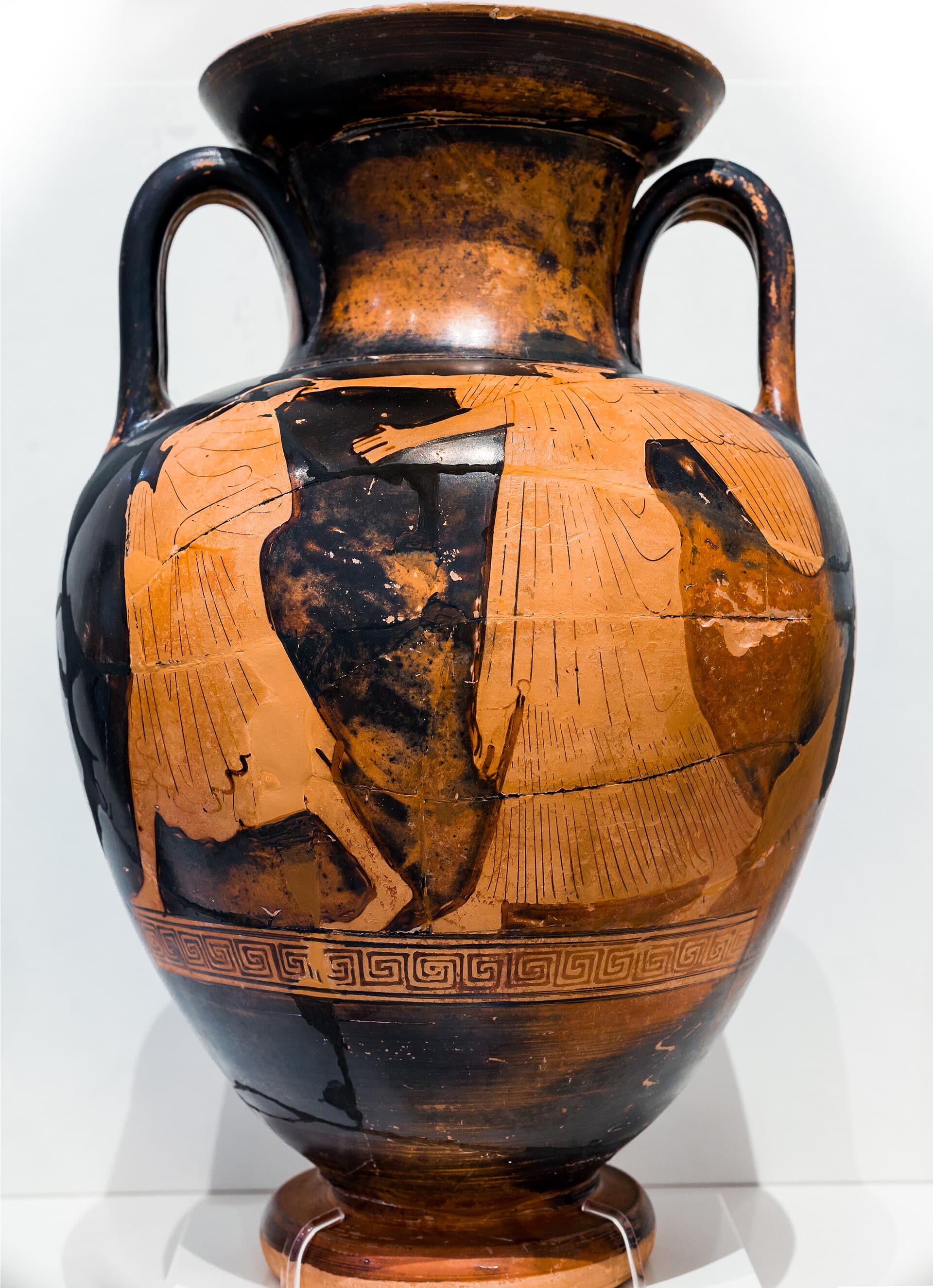
Attic red-figure vase, Syracuse Painter — National Archaeological Museum, Athens 1335
- 3
- epithets
- 0
- cult sites
- 0
- offspring
- 0
- unions
- 1
- recorded birth
Vitals
- Kind
- Titan
- Generation
- 2
- Domains
- the dawn, the beginning of a day
- Accent
- Sun — daylight, the dawn, far-shooting brightness
- Sacred symbols
- the saffron robe, the two-horse chariot, the pitcher of dew
- Principal cult sites
- No cult attested
What they were called
ῥοδοδάκτυλος
rosy-fingered
κροκόπεπλος
saffron-robed
ἠριγένεια
early-born
Lineage
See in the tree
Offspring in this roster
None recorded among the figures modelled here.
Notable myths
Tithonos
Eos took Tithonos and asked Zeus to make him deathless, and Zeus agreed. She had not asked for eternal youth. He grew old past any use, until his limbs failed and nothing was left but a voice going on and on, and she laid him in a chamber behind shining doors. The Homeric Hymn to Aphrodite tells the story as a warning about what a goddess's love does to a mortal body.
Homeric Hymns, Hymn to Aphrodite 218-238
The account
Eos is the most frequently mentioned figure in Homer and one of the least examined. Rosy-fingered dawn appears when the poem needs a day to start, sometimes several times in a hundred lines. Her own story is a pattern rather than an episode: she takes mortal men. Kleitos, Orion, Kephalos, and above all Tithonos, whom she carried off and for whom she asked Zeus for immortality — and forgot to ask for youth. He aged without limit until he could not move and only his voice was left, and she shut him in a room, and later tellings turn him into a cicada. Hesiod pairs her with Astraeus, and they produce the winds — Zephyros, Boreas, Notos — and the morning star and all the stars in the sky. One tradition explains her constant desire as a curse from Aphrodite, punishment for having slept with Ares. It reads as an attempt to give a reason to something the poets had simply always said about her.
Ancient sources
- Hesiod, Theogony 371-374
- Homeric Hymns, Hymn to Aphrodite 218-238
Where a line reference is not given, the work is cited without one rather than guessed at.
Image credit
- Title
- Syracuse Painter - ARV 519 17 - Eos and Tithonos - woman and king - Athens NAM 1335 - 01
- Artist
- ArchaiOptix
- Date
- Unknown
- Licence
- CC BY-SA 4.0
