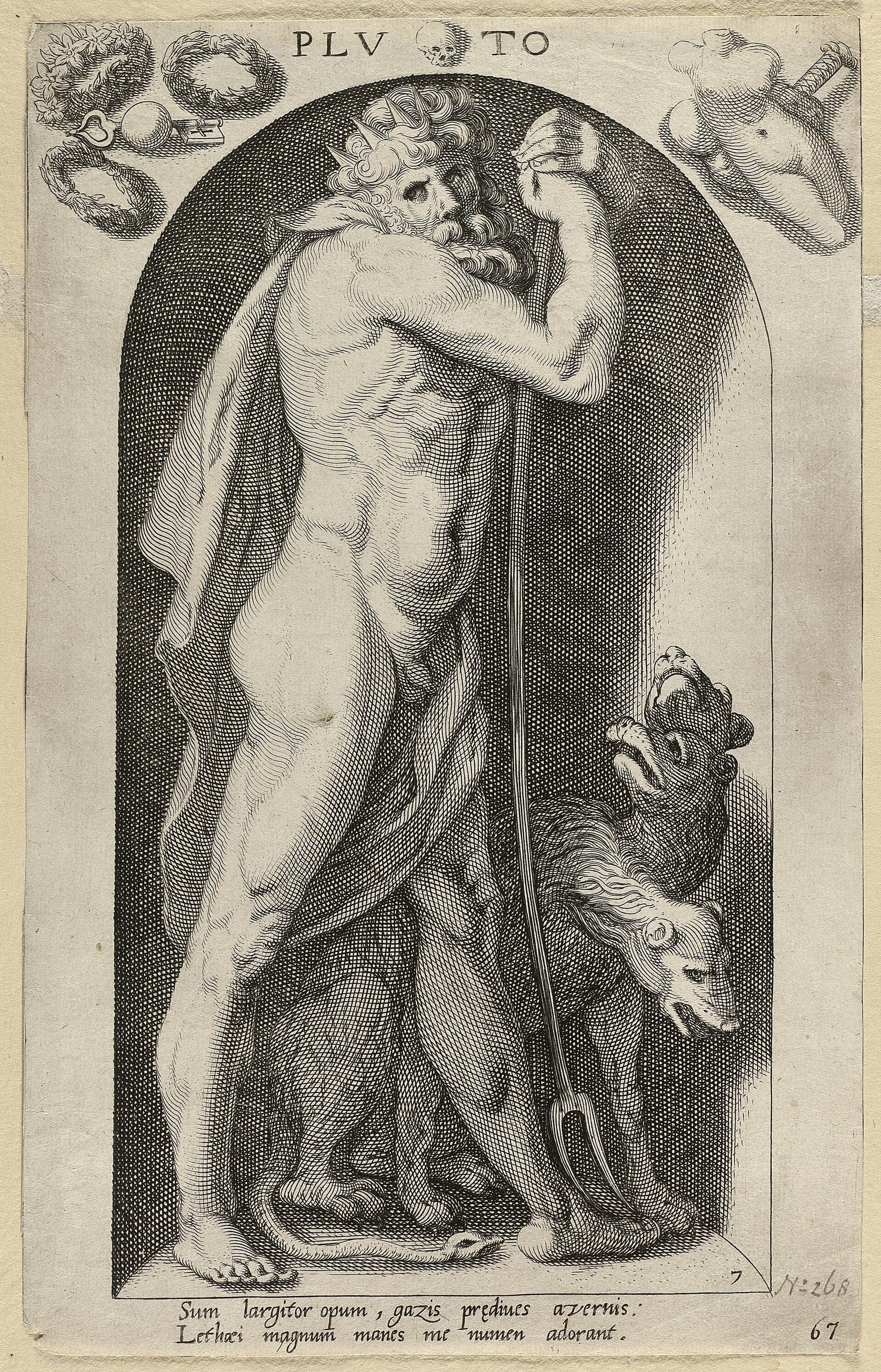
Underworld
Hades
ἍιδηςRoman: Pluto
The one god who cannot be argued with, and the only one who never breaks a bargain.
Engraving, 1598 — Noord-Hollands Archief
- 4
- epithets
- 3
- cult sites
- 0
- offspring
- 0
- unions
- 1
- recorded birth
Vitals
- Kind
- Chthonic
- Generation
- 2
- Domains
- the dead, the wealth under the ground, what does not come back
- Accent
- Underworld — the dead, the pit, what is under the ground
- Sacred symbols
- the cap of invisibility, the sceptre, the cypress, Kerberos
- Principal cult sites
- Elis, Pylos, the Nekromanteion at Ephyra
What they were called
Πλούτων
the wealthy one — a name used instead of his own
κλυτόπωλος
of famous horses
πολυδέγμων
receiver of many
ἀδάμαστος
untamed, unyielding
Lineage
See in the tree
Offspring in this roster
None recorded among the figures modelled here.
Notable myths
The Pomegranate Seed
Ordered by Zeus to give Persephone back, Hades agreed at once and without argument, and then, as she was leaving, gave her a pomegranate seed to eat. Anyone who has eaten in the underworld belongs to it. She returned to her mother, and also had to come back for a third of every year. He did not break the agreement; he made it survive.
Homeric Hymns, Hymn to Demeter 334-374
Orpheus at the Throne
Orpheus went down after his wife and played until the whole underworld stopped: the shades wept, the wheel stood still, and Hades and Persephone agreed to let Eurydike go on one condition, that he not look back before they were out. Ovid, writing under Augustus, says he looked, and she slid back without complaint.
Ovid, Metamorphoses 10.1-77 (Roman-era)
The account
Hades drew the third lot and got the dark. He is not a devil and the Greeks did not think of his realm as punishment; it is simply where everyone goes, and he administers it. He almost never leaves it. Homer calls him the most hateful of gods to mortals, but the hatred is for the destination rather than the management — the Iliad also calls him unyielding and unpersuadable, which is a compliment in a pantheon where every other god can be bought with a hecatomb. His name was avoided in speech, and people said Plouton, the rich one, instead, partly out of nervousness and partly because the wealth that comes out of the ground is genuinely his. He leaves the underworld twice in the surviving stories: once to take Persephone, once to be shot in the shoulder by Herakles at Pylos, after which he went up to Olympos in pain to be treated. In cult he is quiet, poorly attested and sacrificed to at night, downward, with black animals.
Ancient sources
- Hesiod, Theogony 453-458
- Homeric Hymns, Hymn to Demeter 334-374
- Ovid, Metamorphoses 10.1-77
Where a line reference is not given, the work is cited without one rather than guessed at.
Image credit
- Title
- De god Pluto. NL-HlmNHA 1477 53010128
- Artist
- Mander, Karel van (I) (1548-1606), Braeu, Nicolaes (werkzaam ca.1586-ca.1600), Schonaeus, Cornelius (1541-1611), toegeschreven aan
- Date
- 1598
- Licence
- Public domain
