Harvest
Kronos
ΚρόνοςRoman: Saturnus
Cut down his father, then spent an age eating his own children to avoid the same.
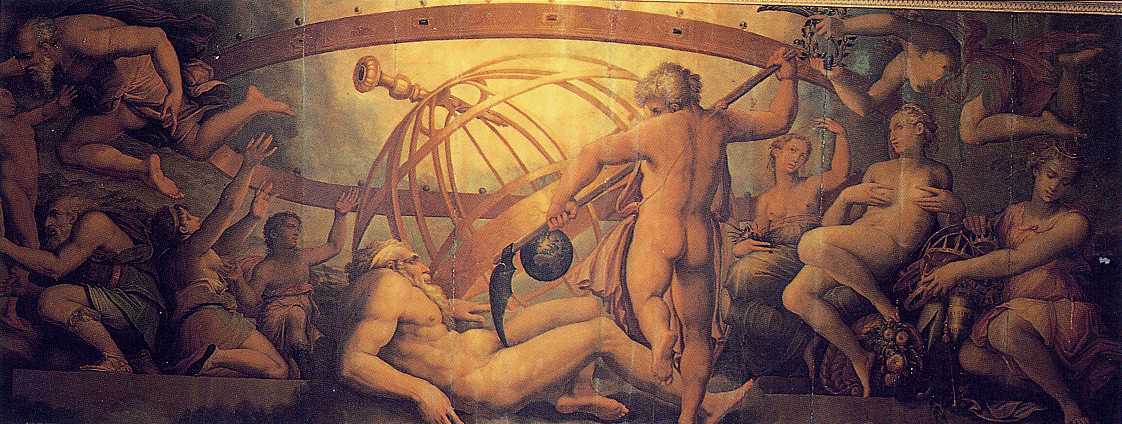
16th century — 'The Mutilation of Uranus by Saturn'
- 2
- epithets
- 2
- cult sites
- 6
- offspring
- 1
- union
- 1
- recorded birth
Vitals
- Kind
- Titan
- Generation
- 1
- Domains
- the harvest, time as it is usually mistranslated, the age before this one
- Accent
- Harvest — grain, the worked earth, the season
- Sacred symbols
- the sickle, the grain scythe
- Principal cult sites
- Olympia, Athens (the Kronia festival)
What they were called
ἀγκυλομήτης
crooked of counsel
μέγας
great
Lineage
See in the tree
Notable myths
The Stone in Swaddling Clothes
When Rhea was about to bear Zeus she went to Gaia and Ouranos for counsel and they sent her to Crete. She bore the child at night on Mount Aigaion and hid him in a cave, then wrapped a great stone in cloth and handed it to Kronos, who swallowed it without looking. He never suspected that his son was alive and growing, and that a stone was sitting where a god should have been.
Hesiod, Theogony 468-491
The Golden Age
Hesiod's other account of Kronos is entirely at odds with the first. In the Works and Days he rules over a golden race of men who lived free of toil and grief, with the earth yielding of its own accord, and who died as if falling asleep. The same poet gives us both the tyrant who eats his children and the king of the age everyone wishes they had been born in.
Hesiod, Works and Days 109-120
The account
Kronos is the youngest and most terrible of the Titans, and the only one of Gaia's sons willing to take the sickle when she offered it. He ambushed Ouranos, unmanned him, and took the rule of the world. Then his father's parting words caught up with him: that his own son would bring him down the same way. So as Rhea bore each child he took it from her and swallowed it whole — Hestia, Demeter, Hera, Hades, Poseidon — keeping them alive inside himself where they could not act. Rhea, on Gaia's advice, gave him a stone in swaddling clothes instead of the sixth, and hid Zeus in a Cretan cave. Zeus grew up, forced Kronos to vomit up the others, and fought a ten-year war. Hesiod sends him to Tartaros. A different and much older strand of tradition remembers him instead as the ruler of the golden age, when men lived without labour and the earth gave crops on its own; the Athenians kept a midsummer festival for him in which masters served their slaves.
Ancient sources
- Hesiod, Theogony 132-138
- Hesiod, Theogony 468-491
- Hesiod, Works and Days 109-120
Where a line reference is not given, the work is cited without one rather than guessed at.
Image credit
- Title
- The Mutilation of Uranus by Saturn
- Artist
- Giorgio Vasari / Cristoforo Gherardi
- Date
- 16 th century
- Licence
- Public domain
