Sea
Poseidon
ΠοσειδῶνRoman: Neptunus
Took the sea by lot, and has never once conceded that it was the lesser share.
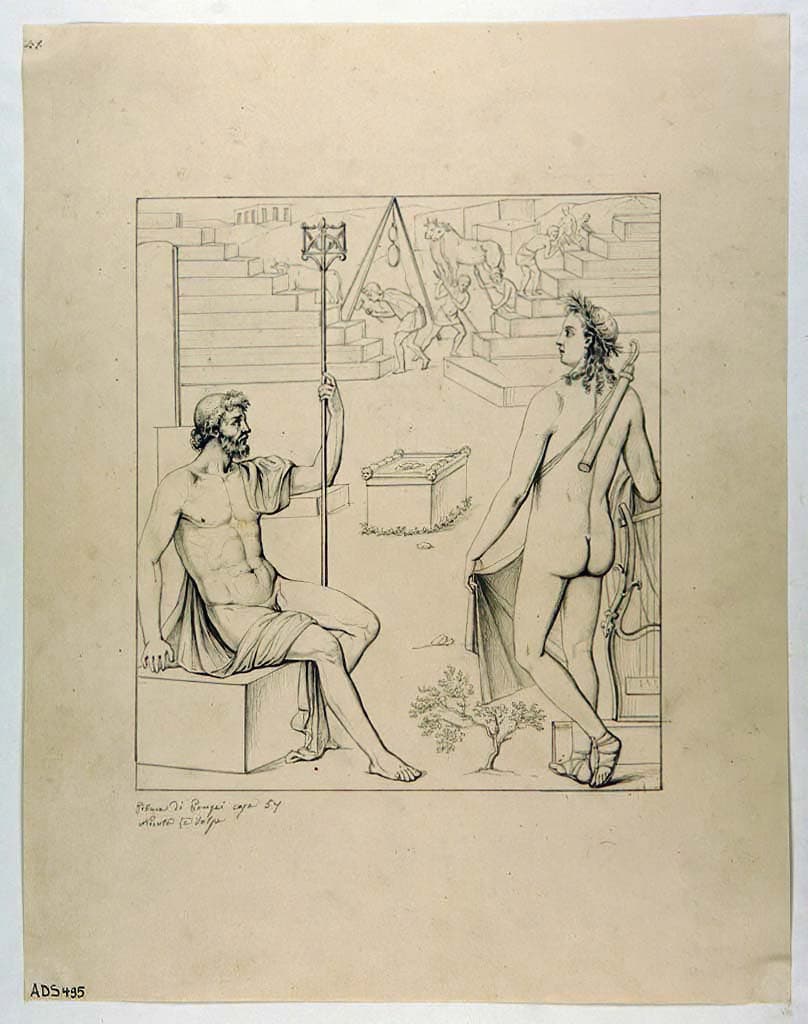
Drawing after a Pompeian wall painting — Nicola La Volpe, 19th century
- 4
- epithets
- 4
- cult sites
- 1
- offspring
- 1
- union
- 1
- recorded birth
Vitals
- Kind
- Olympian
- Generation
- 2
- Domains
- the sea, earthquakes, horses
- Accent
- Sea — salt and fresh water, the swell, the river
- Sacred symbols
- the trident, the horse, the bull, the dolphin
- Principal cult sites
- Sounion, Isthmia, Helike, Onchestos
What they were called
ἐνοσίχθων
earth-shaker
κυανοχαίτης
dark-haired
Ἵππιος
of horses
γαιήοχος
holder of the earth
Lineage
See in the tree
Notable myths
The Contest for Athens
Poseidon and Athena both wanted the city. He struck the rock of the Acropolis with his trident and salt water came up; she planted an olive. The judges chose the olive, because it gave oil, fruit and wood, and the city took her name. Pausanias says the mark of the trident and the salt well were both still on show in his day.
Apollodorus, Bibliotheca 3.14.1
The Grudge Against Odysseus
Odysseus blinded the Kyklops Polyphemos, Poseidon's son, and then shouted his own name back at him from the boat. Polyphemos prayed that the man reach home late, in a stranger's ship, having lost everyone, to find trouble in his house. His father granted all four terms exactly.
Homer, Odyssey 9.526-536
The account
Poseidon holds the sea, and the Greeks also made him responsible for earthquakes and for horses, which sounds like three jobs and was one: he is the god of ground that will not stay still. His temper is the defining feature. In the Odyssey he spends ten years wrecking one man's journey home because that man blinded his son, and he does it with weather rather than confrontation. In the Iliad, told by Iris to withdraw, he answers that he drew his third of the world by lot like everyone else and takes no orders from Zeus, then withdraws anyway, furious and on his own terms. He lost Athens to Athena when the citizens preferred her olive tree to the salt spring he struck out of the Acropolis, and there is a version in which he flooded the plain afterwards. His temples sit on headlands — Sounion above the shipping lane — where the people who needed him most could see them from the water.
Ancient sources
- Hesiod, Theogony 453-458
- Apollodorus, Bibliotheca 3.14.1
- Homer, Odyssey 9.526-536
Where a line reference is not given, the work is cited without one rather than guessed at.
Image credit
- Title
- House of Siricus Exedra 10 19th century drawing by Nicola La Volpe showing Poseidon and Apollo at the walls of Troy
- Artist
- Nicola La Volpe
- Date
- 1st century BCE - 1st century CE
- Licence
- Public domain
