Sea
Triton
ΤρίτωνRoman: Triton
Blows a conch to raise the sea or put it down, on his father's orders.
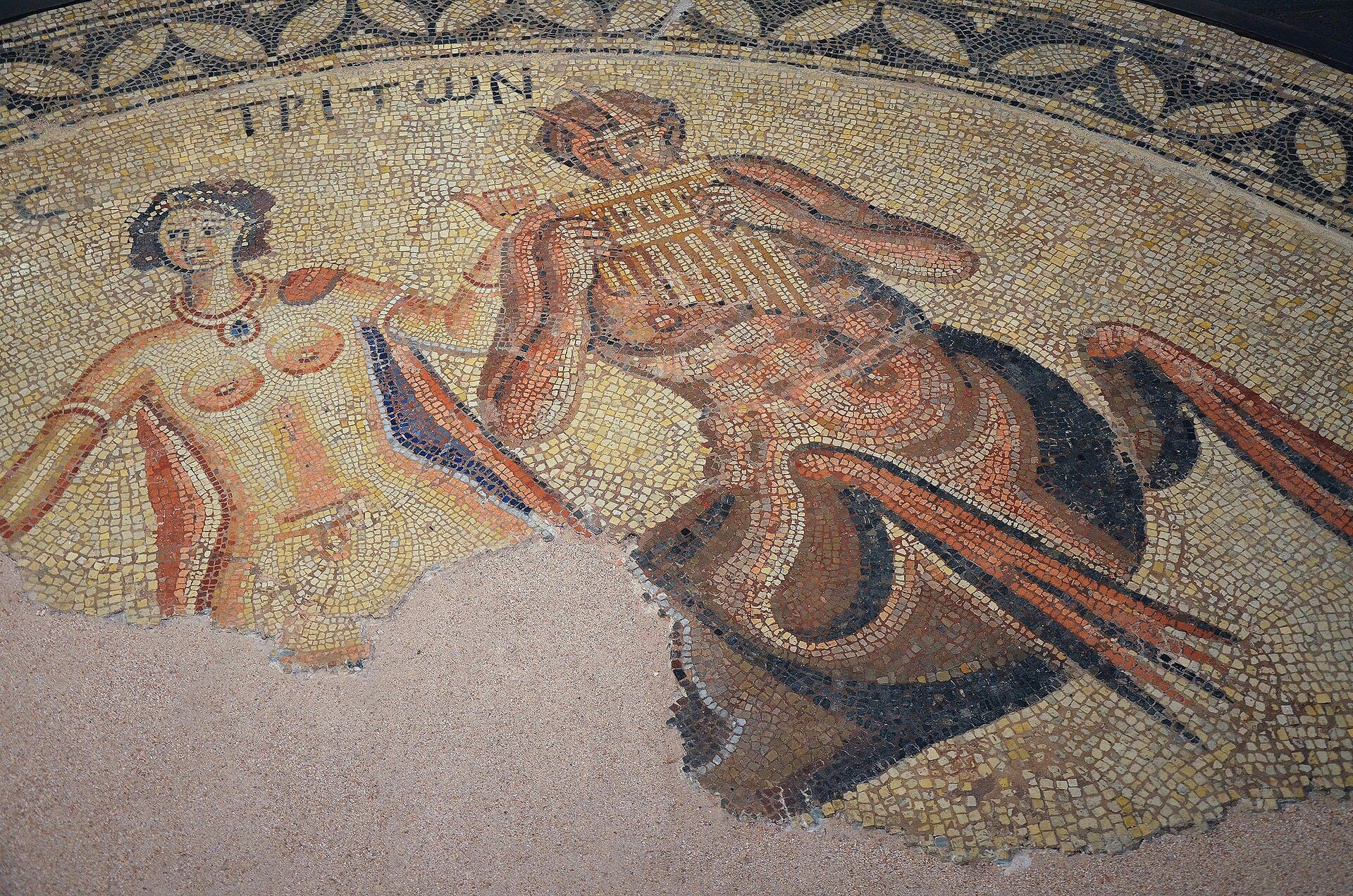
Roman mosaic, 4th–5th century — Musée Saint-Raymond, Toulouse
- 1
- epithet
- 2
- cult sites
- 0
- offspring
- 0
- unions
- 1
- recorded birth
Vitals
- Kind
- Minor god
- Generation
- 3
- Domains
- the sound of the sea, calming and raising water, the harbour
- Accent
- Sea — salt and fresh water, the swell, the river
- Sacred symbols
- the conch horn, the fish tail, the trident
- Principal cult sites
- Lake Tritonis in Libya, Tanagra
What they were called
Τρίτων
a name the Greeks could not explain, probably pre-Greek
Lineage
See in the tree
Offspring in this roster
None recorded among the figures modelled here.
Notable myths
The Conch That Called the Flood Back
When the waters had covered the world, Neptune had Triton rise and blow his sounding shell to recall the rivers and the sea. Ovid says the note went out over all the waters under both sunrises and sunsets, and wherever it was heard the flood held, then fell. It is the clearest picture we have of what he was for.
Ovid, Metamorphoses 1.330-347 (Roman-era)
The account
Hesiod gives Triton four lines: Amphitrite and Poseidon bore great, wide-ruling Triton, who holds the depths of the sea and lives with his dear mother and his lordly father in a golden house, a dread god. In art he is a man to the waist and a fish below, and his instrument is a twisted conch shell, which Ovid describes Poseidon ordering him to sound to call the flood waters back — a note that carries to both shores of the world and makes every river turn round. The Argonauts, stranded in Lake Tritonis and unable to find the sea, are given a clod of earth by a stranger who turns out to be Triton, and he shows them the channel out. By the Roman period he has multiplied into a whole species of tritons blowing horns in the corners of fountains and mosaics, which is the standard fate of a Greek sea god with a memorable silhouette.
Ancient sources
- Hesiod, Theogony 930-933
- Ovid, Metamorphoses 1.330-347
Where a line reference is not given, the work is cited without one rather than guessed at.
Image credit
- Title
- Mosaic depicting the Nereid Thetis, a goddess of the sea, accompanied by a Triton playing the pan flute, discovered in the Roman Villa of Saint-Rustice in 1833, 4th - 5th century, MSR, Musée Saint-Raymond (15636967073)
- Artist
- Following Hadrian
- Date
- Unknown
- Licence
- CC BY-SA 2.0
.jpg)