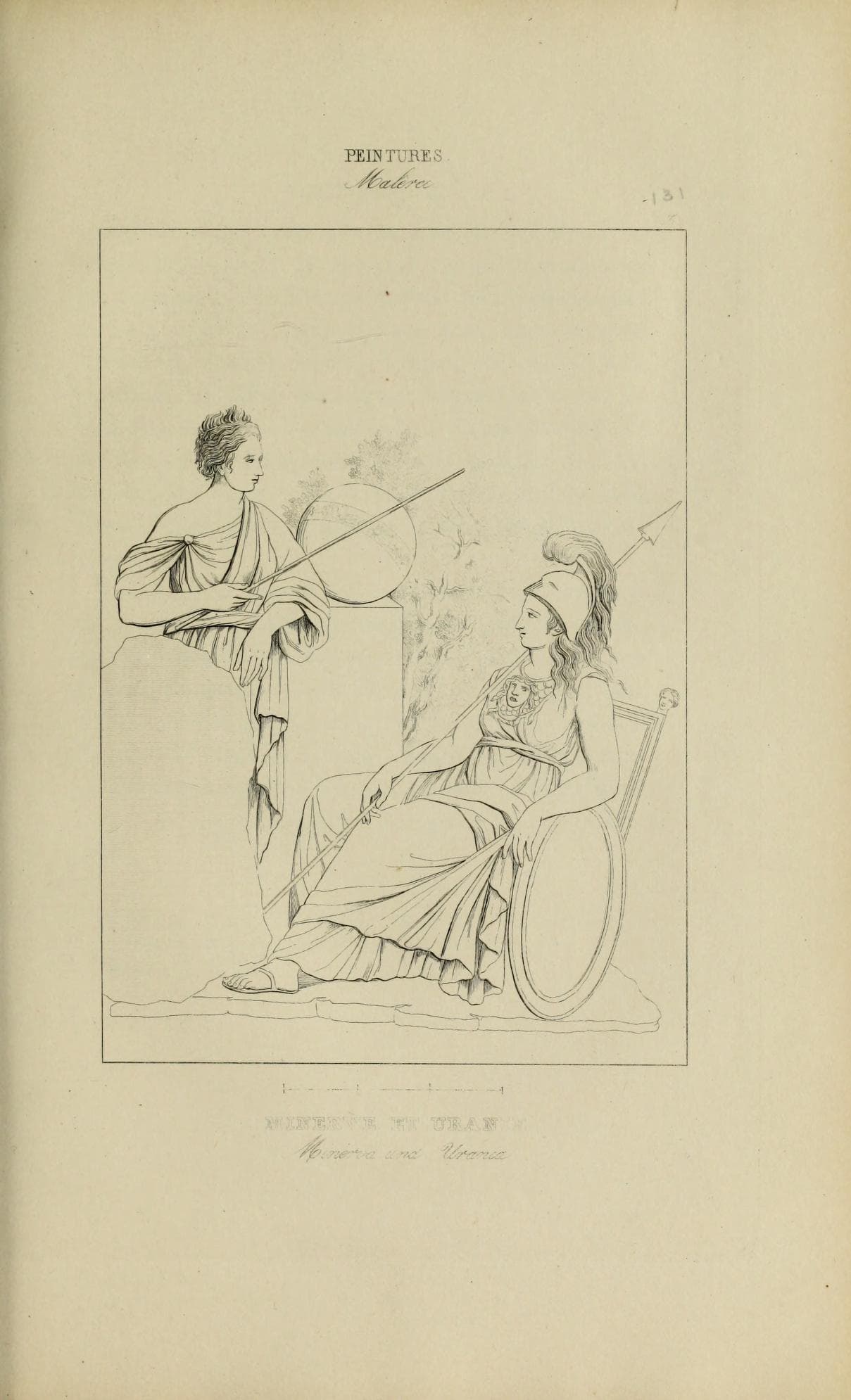
Wisdom
Athena
ἈθηνᾶRoman: Minerva
Born armed out of her father's head, and never once loses an argument.
Engraving after a Pompeian fresco — Barr, plate 131, 1870
- 5
- epithets
- 4
- cult sites
- 0
- offspring
- 0
- unions
- 1
- recorded birth
Vitals
- Kind
- Olympian
- Generation
- 3
- Domains
- strategy, craft and weaving, the city, practical intelligence
- Accent
- Wisdom — counsel, craft, memory, cunning
- Sacred symbols
- the owl, the olive, the aegis with the Gorgon's head, the spear
- Principal cult sites
- Athens (the Parthenon), Lindos, Tegea, Troy
What they were called
Γλαυκῶπις
grey-eyed, or owl-eyed
Παλλάς
Pallas — a name whose origin the Greeks already disputed
Πολιάς
of the city
Πρόμαχος
who fights in the front rank
Ἐργάνη
of the workshop
Lineage
See in the treeDescent
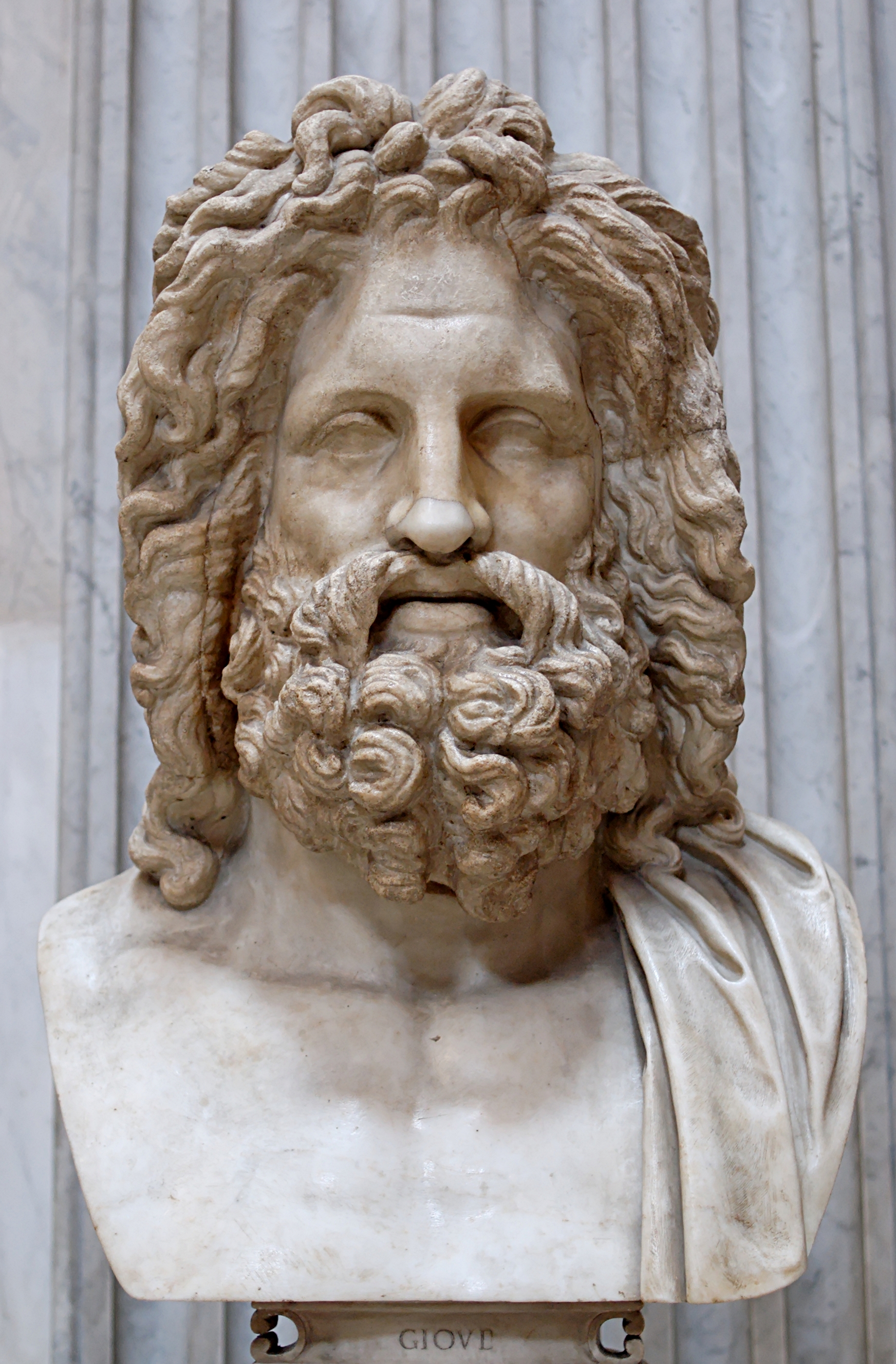 Born from the head ofZeusHesiod, Theogony
Both parents are real. Zeus swallowed Metis while she was pregnant, so Athena was carried to term inside him and came out of his head — which is why the mode is a birth from a body part rather than a parthenogenesis.
Offspring in this roster
None recorded among the figures modelled here.
Notable myths
Born in Armour
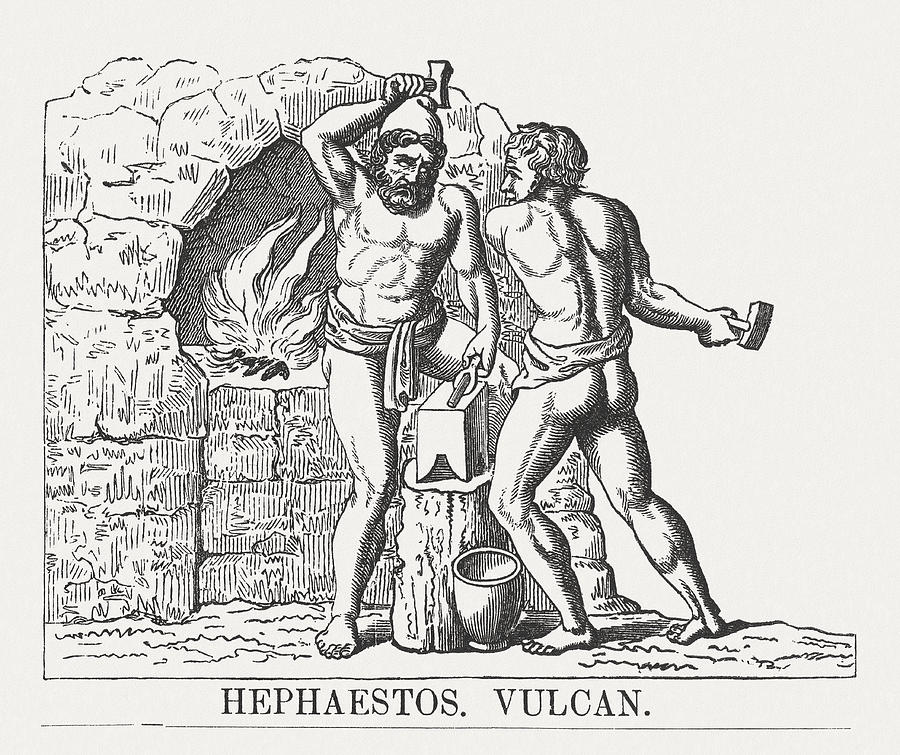
Zeus, having swallowed Metis, was struck on the head — Hephaistos with an axe, in the commonest version — and Athena sprang out fully grown and fully armed, shouting a war cry that shook heaven and earth. Hesiod says she is equal to her father in strength and in wise counsel, and that Zeus produced her from his own head.
Hesiod, Theogony 924-926
The First Jury
Orestes killed his mother to avenge his father, and the Erinyes pursued him for it. Athena refused to judge the case alone and empanelled a court of Athenian citizens instead. The votes came out even; she cast hers for acquittal and then spent the rest of the play persuading the Erinyes to accept a permanent honoured place in the city rather than blight it.
Aeschylus, Eumenides 681-753
The account
Athena's birth is the clearest case in Greek myth of a genealogy that only works if you model it properly. Zeus swallowed Metis to prevent a son, but she was already carrying a daughter, so the pregnancy continued inside him and Athena came out of his head in full armour. Two real parents; an impossible delivery. What she inherits is her mother's kind of intelligence — mētis, the cunning that finds the workable answer — applied to war, craft and civic life. She is the patron of the tactician rather than the fighter, which is why the Iliad has her repeatedly beating Ares, who is only strong. In the Odyssey she is Odysseus's sponsor, and the relationship is unusually affectionate and slightly amused; she tells him she recognises him because he is the same kind of liar she is. She invents the bridle, the ship, the plough and the loom, holds the Acropolis, and in Aeschylus casts the vote that ends the cycle of blood vengeance by inventing the jury.
Ancient sources
- Hesiod, Theogony 886-900, 924-926
- Hesiod, Theogony 924-926
- Aeschylus, Eumenides 681-753
Where a line reference is not given, the work is cited without one rather than guessed at.
Image credit
- Title
- Drawing of a fresco depicting Minerva and the Muse Urania from Pompeii 1870 Barr Plate 131
- Artist
- Barré, Louis, 1799-1857 Roux, H. (Henri), Sr Bouchet, Adolphe; The artist of this particular plate is not identified, however.
- Date
- 1870
- Licence
- Public domain
