Forge
Prometheus
ΠρομηθεύςRoman: Prometheus
Stole fire in a fennel stalk and paid for it every day for thirty thousand years.
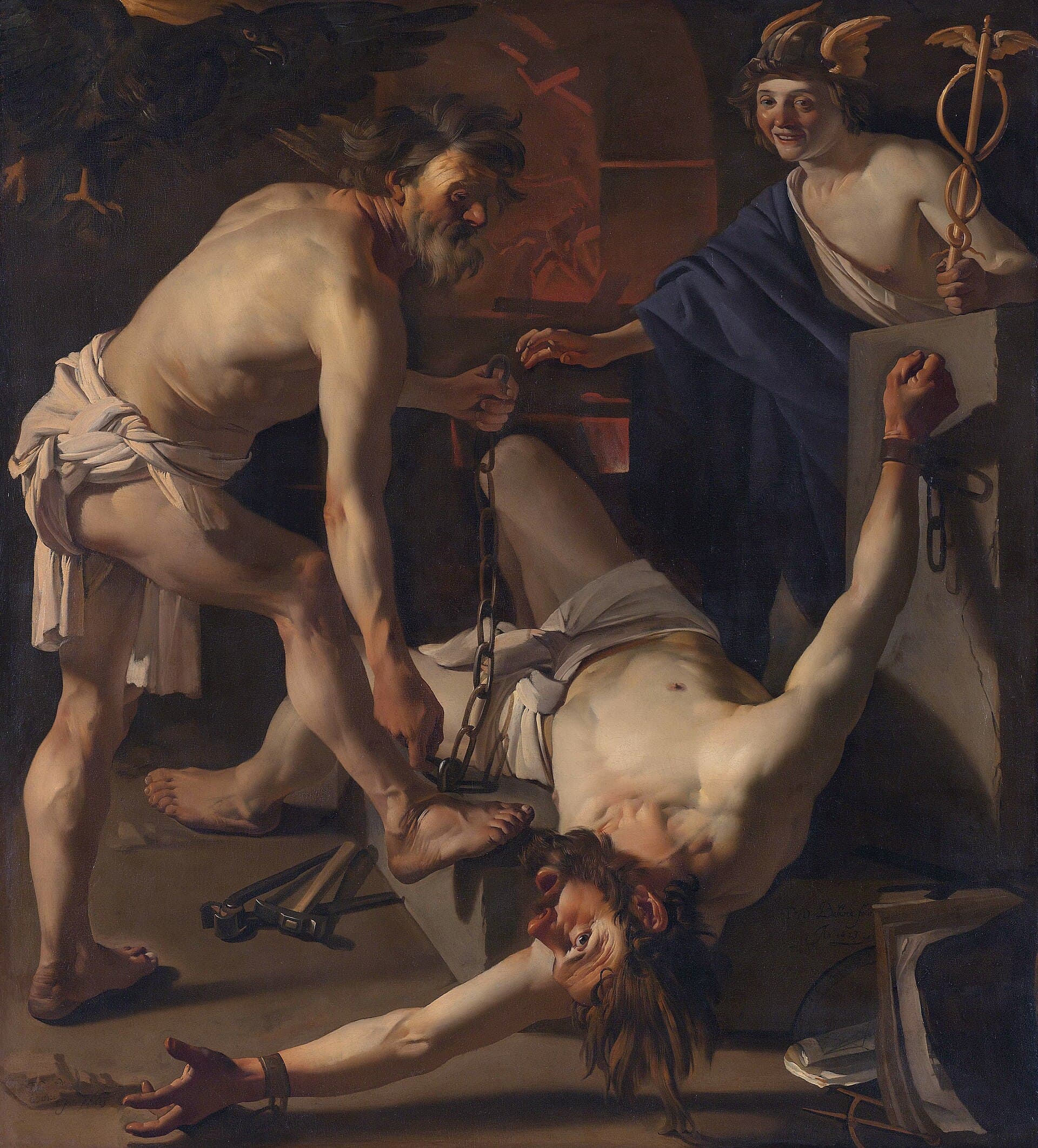
Dirck van Baburen, 1623
- 3
- epithets
- 2
- cult sites
- 0
- offspring
- 0
- unions
- 1
- recorded birth
Vitals
- Kind
- Titan
- Generation
- 2
- Domains
- forethought, fire, craft, the case for humankind
- Accent
- Forge — fire under control, metal, the hearth
- Sacred symbols
- the fennel stalk, the eagle, the chain
- Principal cult sites
- Athens (the Academy), Kolonos
What they were called
ποικίλος
many-coloured, devious
πυρφόρος
fire-bearing
Προμηθεύς
he who thinks ahead
Lineage
See in the treeDescent
His mother is the Okeanid Klymene in Hesiod and Asia in Apollodorus; neither is in the v1 roster.
Offspring in this roster
None recorded among the figures modelled here.
Notable myths
The Division at Mekone
When gods and men were settling accounts at Mekone, Prometheus cut up a great ox and made two portions: the meat and entrails hidden inside the ugly stomach, and the bare bones dressed in shining fat. Zeus took the fat and found bones. Hesiod says he knew and chose it anyway, so that he would have a grievance. The arrangement of Greek sacrifice — bones burned for the gods, meat for the people — dates from that meal.
Hesiod, Theogony 535-560
Fire in the Fennel Stalk
Denied fire, Prometheus stole the far-seen gleam of untiring flame and hid it in a hollow stalk of fennel, which smoulders slowly inside and can be carried a long way. Zeus, seeing the fire among men, bound him and set an eagle on his liver, and sent Pandora down to the human race as the counterweight.
Hesiod, Theogony 561-616
The account
Prometheus takes the side of humankind twice and is punished twice. First at Mekone, where the terms of sacrifice were being fixed, he divided an ox and wrapped the bones in glistening fat and the meat inside the stomach, and invited Zeus to choose; Zeus took the fat, and ever since men have burned bones for the gods and eaten the meat themselves. In return Zeus withheld fire. So Prometheus stole it back, carrying it hidden in the hollow of a fennel stalk, and Zeus had him bound to a pillar with an eagle coming each day to eat his liver, which grew back each night. Zeus also sent the first woman, and with her the jar. Herakles eventually shot the eagle. Aeschylus turns the whole thing into an argument about tyranny and gives Prometheus a further credit: not just fire but number, writing, animal husbandry, medicine and shipbuilding — every art humans have, taken from a god who calculated the cost in advance.
Ancient sources
- Hesiod, Theogony 507-511
- Hesiod, Theogony 535-560
- Hesiod, Theogony 561-616
Where a line reference is not given, the work is cited without one rather than guessed at.
Image credit
- Title
- Prometheus Being Chained by Vulcan
- Artist
- Dirck van Baburen
- Date
- 1623
- Licence
- Public domain
