Messenger
Iris
ἾριςRoman: Iris
The rainbow, and the one sent when Hermes is busy or the errand is Hera's.
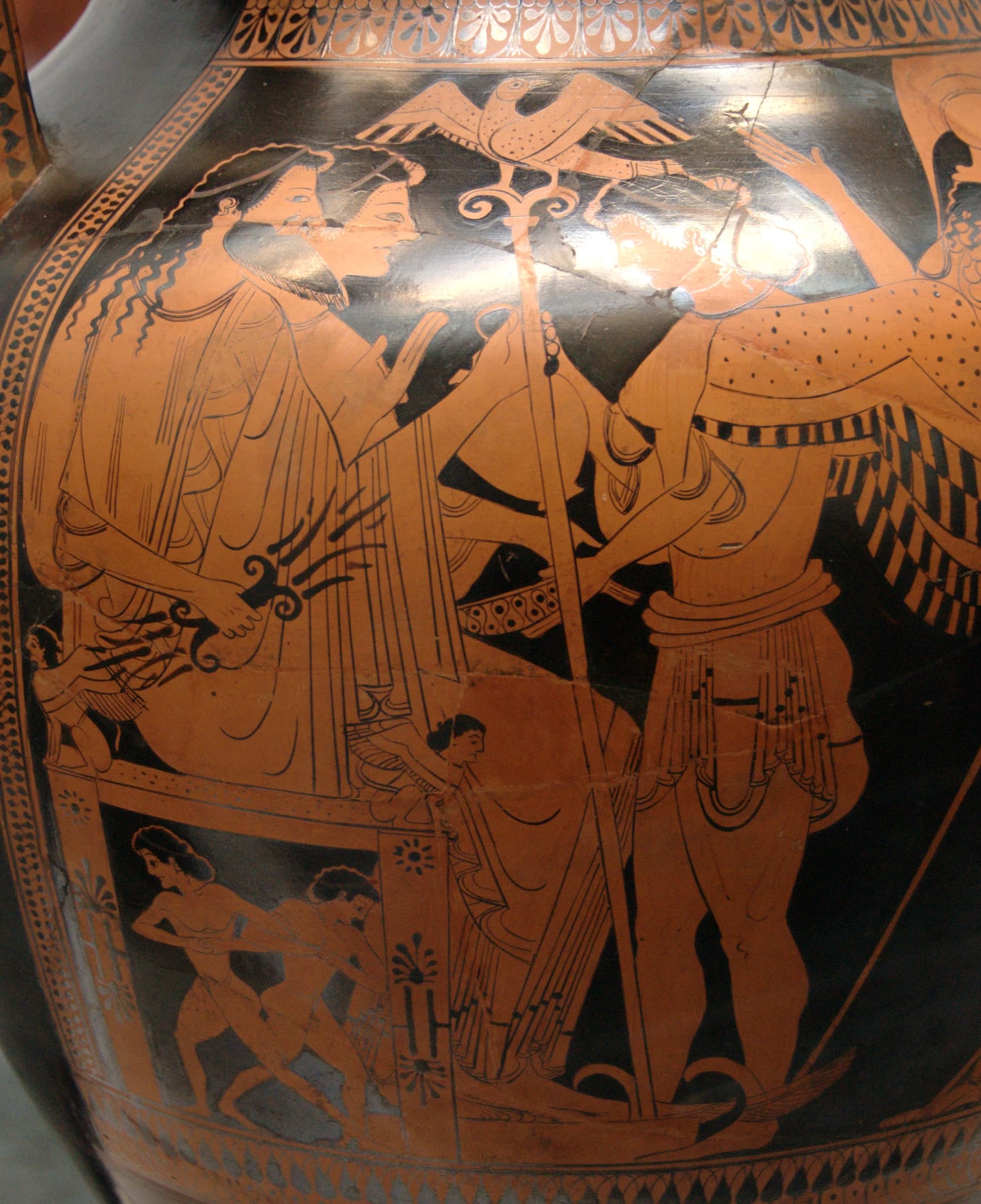
Attic vase — Staatliche Antikensammlungen, Munich 2304
- 3
- epithets
- 2
- cult sites
- 0
- offspring
- 0
- unions
- 1
- recorded birth
Vitals
- Kind
- Personification
- Generation
- 2
- Domains
- the rainbow, the message that must arrive, the oath-water
- Accent
- Messenger — crossings, errands, the rainbow
- Sacred symbols
- the rainbow, the herald's staff, the golden pitcher
- Principal cult sites
- Delos, Hekate's island shrines
What they were called
ποδήνεμος
wind-footed
ὠκέα
swift
χρυσόπτερος
golden-winged
Lineage
See in the treeDescent
Her mother is the Okeanid Elektra, outside the v1 roster.
Offspring in this roster
None recorded among the figures modelled here.
Notable myths
The Golden Pitcher
When there is strife among the immortals and one of them has to swear, Zeus sends Iris to bring the water of Styx in a golden jug from the far cold place where it drips down through black night. Perjury on it costs a god a year without breath or voice and nine more shut out of the councils and the feasts.
Hesiod, Theogony 780-806
Sent to Demeter, and Refused
With the earth barren and humanity dying, Zeus sent Iris first — running the long way to Eleusis and finding Demeter sitting in her temple in a dark robe. She delivered the summons exactly. Demeter would not be persuaded. Iris is the only messenger in the hymn whose message simply fails.
Homeric Hymns, Hymn to Demeter 314-324
The account
Iris is a rainbow and a messenger, and the Greeks saw no distance between the two: a rainbow is a line drawn from the sky to the ground, which is what a message is. She is wind-footed and storm-swift, and in the Iliad she does most of the running, carrying orders from Zeus to Poseidon, to Hektor, to Achilles, and taking Hera's errands when Hera would rather Hermes did not know. She goes down into the sea to fetch Thetis and sits in the middle of the Trojan assembly disguised as a man. Hesiod gives her the other duty, which is more formal: when a quarrel breaks out among the gods and an oath is required, Zeus sends Iris to bring the water of Styx from far off in a golden jug, and a god who swears on it falsely is unconscious for a year and outcast for nine more. She is the only figure who travels routinely between Olympos, the sea and the underworld without any of them being her home.
Ancient sources
- Hesiod, Theogony 265-266
- Hesiod, Theogony 780-806
- Homeric Hymns, Hymn to Demeter 314-324
Where a line reference is not given, the work is cited without one rather than guessed at.
Image credit
- Title
- Zeus Hera Iris Staatliche Antikensammlungen 2304
- Artist
- Nikoxenos Painter
- Date
- Unknown
- Licence
- Public domain
